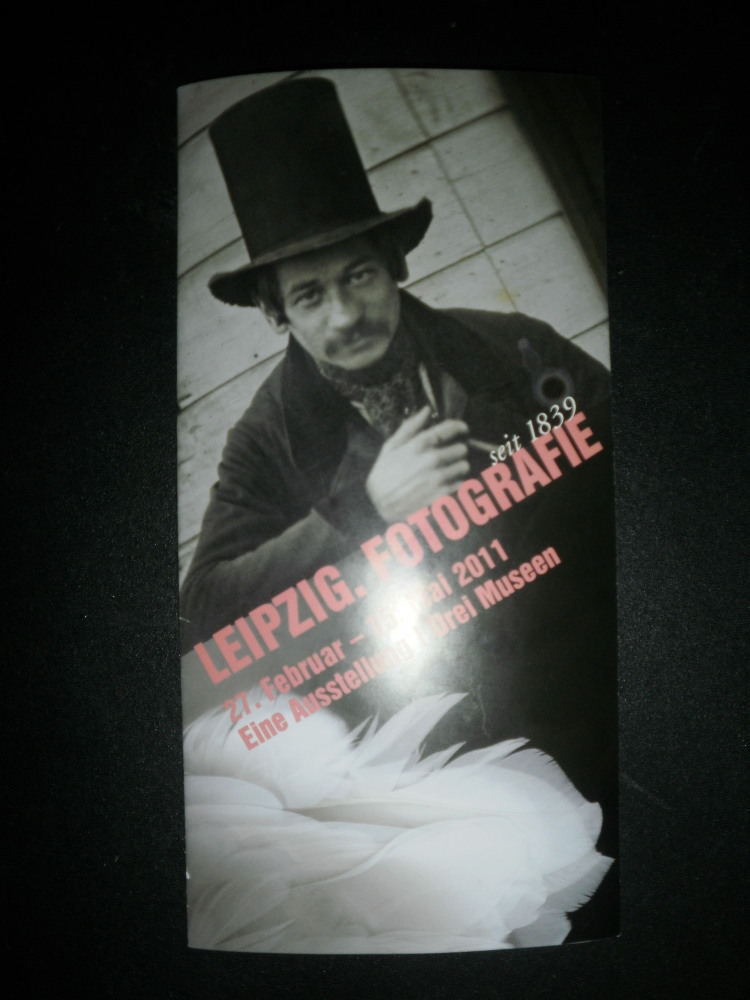
exhibition in Leipzig. Photography since 1839. Having now established that there this year, not a continuation of the great F / will stop festivals (the cruiser
reported), we enjoyed the museums of the city with a large current Photo exhibition, which was evenly distributed over several houses.
As the name suggests, takes the exhibition "Leipzig. Photography since 1839" the visitor on a journey through the development of the photographic process from its beginning until the present time. What is special is that almost all exhibits are shown, which were made by photographers or reflect the Leipzig Leipzig motives. It is familiar not only with the technology but acquires a quasi "in passing" urban historical knowledge.
"This exhibition is the extraordinary photographic tradition Leipzig and the history of this medium to rediscover our city, which includes also the data stored in the museums, libraries and archives of photographic treasures from many origins and history. The exhibition also has on the high rank of today's visual-photographic media and the importance of the media in Leipzig, Hin. "
The three participating museums are the GRASSI Museum of Applied Arts, the City History Museum and the Museum of Fine Arts.
On Wednesday I watched two of the stations.
It was I, unfortunately, not possible from the exhibition rooms even to take pictures, so it is now somewhat theoretical, but I hope it only increases the allure of visiting the exhibition.
GRASSI Museum of Applied Arts Leipzig The Grassi Museum displays works from the period from 1839 to 1917. In order to offer you a bit more background knowledge than the flyer, I have again brushed off busy museum texts. A man then asked me smile if I here transcribe just the preface for my doctorate. I've obviously not made, all records are meant only for this blog. Quotes you recognize me in the way, always remember that they are printed in italics and indented; I usually sit on and even quotation marks. Just so we understand each other.
Here is the opening of the museum:
"Photography and the threat of her fascination with form from the beginning till today an inseparable unit, the rich in inventions and discoveries of 19th century photography rose the most popular novelty of the era, the.. to enthusiasm about the possibility of the reality around at will see an exact replica or "freeze" a particular moment may be, in a transformed and modern, enlightened way remained to the present life. also remains is the appeal to "explore" Photographs , to discover images in the image and not a few photographs of the strange mystery to get on the track. This exhibition is part of photography from the earliest times to the early 20th Century devoted to making, but also attention to photographic artists of our day who go in the third century of the photography on their own, very different picture search -. Self-confident, doubting, curious "
From the early daguerreotypes (established 1850) is its unique allure of the one hand there would be what is depicted.. not just clothing and environment of the people are interesting, even the facial expressions often appear strangely alienated and cold I do not know what it was that appear to human eyes on the paintings so glassy and empty can. If the motives is to strictly segregated: men sit together in groups, smoking and or think, women are usually shown only with children or getting dressed. Most often they were shooting individual portraits, which were thoroughly arranged completely. For example, such an officer before "painted background" showed that I had not recognized as such and reminded me very realistic photo wallpaper.
The image "Carl Dauthendey as hunters" also shows that the first cameras already in the "wild" and not just in the studio (then the name was probably the studio) were used.
Furthermore caused by material and present the impression of exclusivity. The images are often very small, but always imaginatively decorated with beautiful frame. The exhibition will be shown specifically for daguerreotypes made (probably derived from the U.S.) cases of leather, wood, paper and velvet. Digital frame presents a mundane in comparison, only the throw-away mentality of today's (plastic) society.
Even if some of the daguerreotypes are now faded strong, has a majority of the images on an amazing brilliance and after a while you feel really 160 years back.
At this point, introduced the concepts calotype (the first negative-positive process on paper) and Ambrotype (image-bearing glass). Moreover, one can get a galvano impression of a daguerreotype and amazingly accurate engravings von Auguste Hüssen.
Later dei exhibition is dedicated to the work of Edward and Bertha Wehnert Beckmann, a pair of major photographers of the city.
"your meeting, and both residents are working together in Leipzig can be regarded as the highlight of the early history of the medium and a photographic history of this city."
to that a little theory:
"The early days of Lichtbildnerei essentially based on the Louis Jacques Mandé Daguerre (1787 - 1851) are with iodine vapors made sensitive to light and exposed developed unique technology of the daguerreotype in the polished silver-coated copper plate. visible positive image is formed on exposure to mercury vapor, which combines with the silver.
William Henry Fox Talbot created its own conditions for the negative-positive process based on paper. "
From now on, you could reproduce any images, and despite the brilliance of the daguerreotype was against this Procedure does not prevail. (Similar to the triumph of digital photography was later not be stopped.)
are disadvantages of the daguerreotype, the mechanical and chemical sensitivity and the viewing mirror aggravating effect.
It was a wonderful series, "You are looking at a happy man" by Jörn Lies (2009). It is about 12 digital C-prints, which I did not get behind it if there were models of the present time now, in old clothes ready and their photos were then manipulated or whether old photos were photographed or otherwise altered.
The rear exhibition space devoted to historical recordings. There are example images from World War II (Soldiers in the trenches or on a bomber), visible from the main railway station in 1916, by Augustus place for the opening of the Battle Monument in 1913 and from the gymnastics festival in the same year.
"Leipzig had a very dense collection of photographic studios" , it is not surprising that the urban renewal has been well documented.
brings us to the local historical aspect. I was neither the (long demolished)
Roman House a term, nor do I recognize the Roßplatz in its original form with the hotel of Prussia and the Café Bauer
again.
"The impressive images of the under construction or completed station the fascination of the enormous technical development convey at this time, a development that also includes the construction of bombers during World War II. "
The museum shop, I then saw two beautiful books that I would recommend:
Olaf Martens " Dreams / worlds / background " Photography 1984-2004 Please visit his website
, there is plenty to see many extraordinary images.
"Design Destinations Worldwide , published in the HF Ulman Published on whose
Homepage find her an insight into the 800-page tome on dei perfect combination of architecture and design.
Museum of City History is here examines the history of photography from 1918 to 1961. This part of the exhibition but I did seen yet, so just the teaser:
"The photo exhibition at the City History Museum covers the period from the end of the First World War to the building of the wall footage of George Zschäpitz prove the only rare traditional imagery of National Socialism. . For the end of the Second World War is the famous photos of the "last dead of the Second World War" by the American Robert Capa, the photographs of John Widmann, report on the shocking way of war damages. The touching simplicity with which the indefatigable Reporters of everyday life "Karl Heinz May from his disability wheelchair out people and everyday life in the postwar period is documented, as well as highlighted the work of the representatives of the" action photography ", FOR Bernstein, WG Schroeter and Roger and Renate Rössig that are available for aesthetic upheavals and the early GDR development. "
Museum of Fine Arts Leipzig devotes the third part of the series in the period between the Wall and today. Focus is of course the East German photography. Images from this time to hit me again and again. I do not know why, but the most depressed young people have the eyes I have ever seen, even if they laugh. Aside from the then fashionable perm, their faces actually differ little from those of today's teenagers, but something is behind her eyes. This is particularly clear in the series "close grip" (1982/83) by Christiane Eisler and "real mode (disco)" by Uwe Frauendorf.
pictures I have also agreed to were very, "There was fish," "The world is colorful and beautiful" (a mountain of sweets, it could also be pills) and "The Sun is shining in the dark. "Annett Stuth Recording" Bunker WB VII "shows a pink lit bunker and takes this so his threat
Peter Franke made." Maja ". Here, the boundaries between painting and photography
had a great effect blur . recording "tree Each 5" by Ricardo Rogga From a distance I thought, "What is for there for a big black stain on the wall" But when I got closer, I realized that these are branches of a tree
. In the same room, a shelf of books is set up. Look in the book "In the Moonlight" by Erasmus Schröter, is waiting for you moody DDR designs. Has struck a nerve with me.
Similarly, the series "mining. The Pit Martin Hoop in Zwickau. The dirty, naked workers have irritated me comfortable.
For those who have now got the desire to look at the issue, another note: Next Wednesday (. 09.03) in the entry in the MDBK free lunch and you have the museum almost by itself. A little side note: I like the exhibition rooms in MDBK much, but I find the staff often disturbing. The "guards" are either too intrusive (for my taste) or yap all the time into their walkie talkies, even though they are almost next to each other ...
The exhibition runs until 15 May 2011.
addition, there are two partners in the City Exhibitions:
trigger. Photographic Concepts in Leipzig Kunsthalle der Sparkasse, Otto-Schill-Straße 4a, 04109 Leipzig
Tue, Thu-Sun 10-18 Clock, Wed 12-20 Clock
Open until 13 March
The Leipzig photographer John Mills (1876-1952). A rediscovery Camera and Photo Museum Leipzig, Gottschalkstr. 9, 04316 Leipzig
Wed, Sat, Sun 13-17 Clock
Open to 15 May
All other formal information go to the page
Leipzig. Photography . By the end of the exhibition are always lectures and Guided tours, looks just into the program.